

Global Tech Divide Deepens as AI Regulation Takes Center Stage
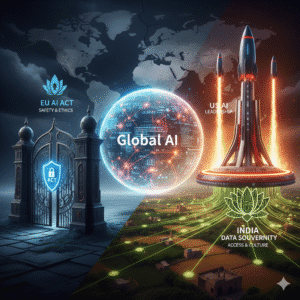
October 19, 2025 – The global landscape of Artificial Intelligence (AI) development is rapidly diverging, with a clear split emerging between regulatory bodies focused on control and national governments prioritizing speed and domestic security. This growing divergence, exemplified by the stringent new rules of the European Union’s AI Act and the more innovation-focused strategies of the United States and India, marks a pivotal moment in how this transformative technology is shaped and deployed worldwide.
The EU's Landmark AI Act: A Precedent for Global Regulation
The European Union’s landmark AI Act, with its provisions on General-Purpose AI (GPAI) models coming into effect this year, has established the most comprehensive regulatory framework yet. By classifying AI applications into different risk categories, the EU is doubling down on a human-centric, safety-first approach.
Key aspects of the EU AI Act include:
- Risk-based classification: AI systems are categorized from 'unacceptable risk' (e.g., social scoring, which is banned) to 'high-risk' (e.g., in critical infrastructure, employment, law enforcement) which face strict compliance obligations.
- Transparency for GPAI models: Providers of powerful General-Purpose AI models are now mandated to publish summaries of their massive training datasets.
- Focus on human oversight: Emphasis on human supervision and control over AI systems to ensure safety and ethical use.
The US and India: Accelerating Innovation and Data Sovereignty
In stark contrast to the EU’s regulatory push, nations like the United States and India are pursuing distinct but equally impactful strategies.
The US: Innovation-First and Market Dominance
The United States is accelerating its own strategies, such as the recently published “Winning the AI Race: America’s AI Action Plan,” which explicitly prioritizes reducing regulatory barriers to innovation and expanding the global reach of US AI exports. The goal is to solidify American leadership in the AI market, viewing rapid development as key to both economic and national security.
A Fragmented Future: Geopolitical Tensions and Trade
This bifurcated global approach—one side pushing for deep regulatory safety, and the other for accelerated, domestic-first innovation—sets the stage for future geopolitical tensions, potential trade disputes over technology standards, and a fragmented global digital ecosystem. As AI rapidly moves from a specialized tool to the backbone of modern infrastructure, the choice between regulation, speed, and data sovereignty will determine its long-term ethical and economic impact on billions of lives.
Frequently Asked Questions (FAQs)
What is the EU AI Act?
It is a groundbreaking regulation from the European Union that classifies AI systems by risk level and imposes legal obligations on developers and deployers. Its goal is to ensure AI is safe, transparent, non-discriminatory, and environmentally friendly.
Why is AI data sovereignty important?
Data sovereignty, in the context of AI, means a nation ensuring its citizens’ data is governed by its own laws and that the AI models serving its people are trained on datasets that reflect its local context and culture, minimizing foreign bias.
What does ‘GPAI’ stand for?
GPAI stands for General-Purpose AI, referring to advanced AI models (like large language models such as the one you are interacting with) that can be adapted to a wide range of tasks, rather than being built for a single, specific purpose. The EU AI Act places specific transparency obligations on their developers.
How does this affect my business?
For businesses using AI, this regulatory split means increased complexity. Companies operating globally must now navigate stricter compliance costs (like those mandated by the EU) while also competing with faster, less-regulated innovation in other markets. Compliance with ethical AI standards is becoming a core business requirement.
Is this a short-term trend?
No. The rise of AI and the global effort to govern it is a long-term trend. Policy, ethical, and economic debates about AI’s role in society are expected to dominate global discourse for the next decade and beyond.
